

The Documenta Madrid International Documentary Film Festival, organized by the Department of Culture, Tourism and Sport, will hold its 23rd edition from May 26 to 31 at Cineteca Madrid and four additional venues across the city: Filmoteca Española, Museo Nacional Centro de Arte Reina Sofía (MNCARS), La Casa Encendida, and Goethe-Institut. Under the artistic direction of Luis E. Parés, this year’s program is structured around the concept “Taking the Pulse,” a look at direct cinema that highlights its ability to capture contemporary reality without mediation, recording its tensions, conflicts, and transformations in real time.
Within this framework, the parallel sections are consolidated as one of the festival’s core pillars, offering a journey through different ways of understanding cinema as a testimony of its time.
Images in Conflict: Third World Newsreel and cinema as a political tool
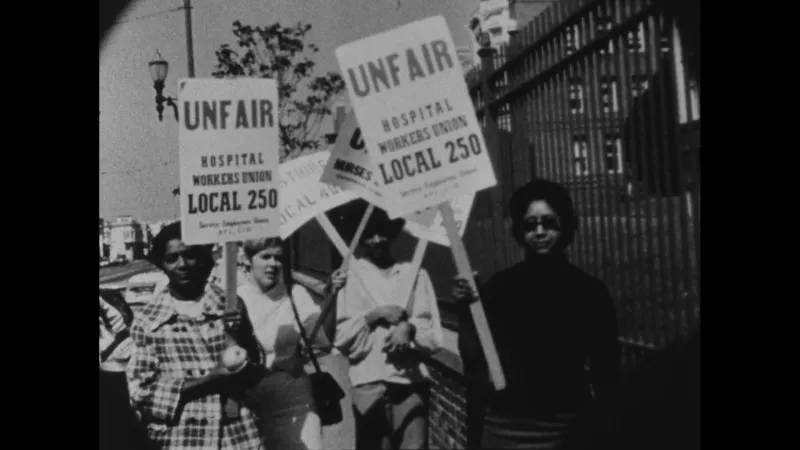
In collaboration with Filmoteca Española, Documenta Madrid presents a retrospective dedicated to the collective Third World Newsreel, one of the most radical experiences of militant cinema to emerge in the United States between 1968 and 1972. Conceived as an urgent and collective practice, this movement used film as a tool to document social struggles ignored by mainstream media.
The program brings together, in four sessions, a selection of key titles such as Columbia Revolt (1968), screening May 27; The Woman’s Film (1971), on May 28; El pueblo se levanta (1971) and Break and Enter (1971), both on May 29; along with short pieces such as Garbage (1968) and Chicago Convention Challenge (1968), to be shown on May 29 and 30 respectively. Through these films, the program traces a journey through student movements, feminism, housing struggles, and the rise of Black Power, revisiting a cinema that not only documents history but intervenes in it.
Charlie Shackleton and the deconstruction of documentary
La Casa Encendida hosts the first retrospective in Spain of British filmmaker Charlie Shackleton, one of the most distinctive voices in contemporary non-fiction cinema. His work occupies a hybrid territory between documentary, essay, and formal experimentation, questioning narrative conventions and the mechanisms through which audiovisual storytelling is constructed.
The program includes titles such as Beyond Clueless (2014), on May 26; The Afterlight (2021), on May 27; and Zodiac Killer Project (2025), on May 29. In addition, a session of video essays will take place on May 28 featuring works such as Copycat (2016), Fish Story (2018), and Camera Test (2024), as well as a workshop with the filmmaker on May 27. Through these works, Shackleton dismantles the codes of true crime and classical documentary, offering a critical reflection on the relationship between image, viewer, and truth.
Memory and exile: the “filmed letters” of Marilú Mallet
MNCARS, in collaboration with Documenta Madrid, presents a retrospective dedicated to Chilean filmmaker Marilú Mallet, a key figure of the first generation of women directors in Chilean cinema. Her work, shaped by exile following the 1973 coup d’état, unfolds as an intimate exploration of memory, identity, and distance.
The program brings together four essential films from a body of work that combines the autobiographical with the political: Andahuaylillas (1983) and El evangelio de Solentiname (1978), both on May 29; Diario inacabado (1982) and Doble retrato (2000), on May 28; and Geografía personal (2016), on May 31. Through these “filmed letters,” Mallet constructs a deeply personal perspective on recent history, positioning cinema as a space for emotional and narrative reconstruction.
The cycle will be completed on May 30 with a tribute to two Chilean filmmakers who also experienced exile: Valeria Sarmiento, with Huellas (2023), and Angelina Vázquez, with Dos años en Finlandia (1975).
Jan Soldat and the limits of intimacy
The ECAM Meeting, held across Cineteca Madrid, Goethe-Institut, and the Madrid School of Film and Audiovisual Arts (ECAM), will be dedicated to German filmmaker Jan Soldat, whose work is characterized by a direct exploration of intimacy, bodies, and power dynamics. His cinema ventures into rarely represented territories, constructing a complex portrait of society that probes the hidden side of contemporary morality.
The program, curated by ECAM documentary students, is structured into four retrospective sessions. Two will take place at Cineteca Madrid on May 27 and 30—“Happy Preparations” and “Fetish and Power”—featuring titles such as Das Spielzimmer (2024) and Die Unfertige (2013). Two more will be held at Goethe-Institut on May 28 and 29—“Personal Space” and “The Desire to Love”—with films such as Open House (2025), Blind Date (2022), and Coming of Age (2016). Additionally, a masterclass will be held at ECAM on May 28 focusing on the creative and ethical processes behind his work.
Hidden territories: Slovenian experimental cinema and film recoveries
The parallel program is rounded out by the cycle “A Hidden Avant-Garde: Slovenian Experimental Cinema” (May 29 and 31), curated in collaboration with the Slovenian Cinematheque. It brings back little-known works by filmmakers such as Vinko Rozman, Karpo Godina, and Vasko Pregelj, offering insight into a marginal yet essential strand of European experimental cinema.
This program is complemented by special sessions such as “The Adventures of a Lumière Operator Around the World,” in which filmmaker Javier Rebollo will provide live commentary on May 26 for films shot by Lumière cameraman Gabriel Veyre, a pioneer in filming across different countries at the end of the 19th century. It also includes the recovery and presentation, on May 31, of previously unseen materials by cameraman and correspondent José Luis de Pablos, in collaboration with the ECAM Archive, allowing audiences to revisit major political and social events of the 20th century from a cinematic perspective.
Documenta Madrid 2026
Documenta Madrid is the City of Madrid’s International Film Festival and one of Spain’s leading platforms for exhibition, reflection, and creation around non-fiction cinema. In its 23rd edition, the festival reaffirms its commitment to cinema as a tool for observing the present, promoting auteur filmmaking, formal experimentation, and dialogue with the history of the seventh art. Organized by Cineteca Madrid, the festival maintains its three competitive sections—international, national, and final cut—alongside a parallel program spread across various venues in the city, including Filmoteca Española, En nuestra propia tierra, La Casa Encendida, and Goethe-Institut, consolidating its role as a meeting point for filmmakers, professionals, and audiences.
More info: documentamadrid.com
Press contact for inquiries and interview requests: prensa@documentamadrid.com

 DocumentaMadrid